Understanding the Driver Exemption Log Book: A Complete Guide for Commercial Drivers and Fleet Managers
If you're a commercial driver, an owner-operator, or a fleet manager, you already know that staying compliant with hours-of-service (HOS) regulations is not optional. But what happens when an unexpected delay, a mechanical breakdown, or adverse weather forces you to adjust your schedule? That's where a driver exemption log book becomes essential. This guide explains everything you need to know about exemption logging, why it matters, and how using a dedicated log book can protect your license, your livelihood, and your safety record.
Whether you're new to the trucking industry or a seasoned professional looking to tighten your record-keeping, this article will walk you through the purpose, practical use, and common pitfalls of exemption logs. Let's start from the ground up.
What Is a Driver Exemption Log Book?
A driver exemption log book is a specialized record-keeping tool used by commercial motor vehicle (CMV) drivers to document circumstances where they qualify for an exemption from standard hours-of-service rules. Under the Federal Motor Carrier Safety Administration (FMCSA) regulations, drivers are generally limited to 11 hours of driving after 10 consecutive hours off duty, and they cannot drive beyond the 14th hour after coming on duty. However, certain situations allow for limited exceptions.
These exceptions must be documented in detail at the time they occur. An exemption log book provides a structured format to record the nature of the exemption, the time it started and ended, the reason for the exemption, and any supporting notes. Without this documentation, a driver could face serious violations during a roadside inspection or audit.
Think of it as your official record of why you deviated from the standard rules. It's not a loophole to bypass regulations. It's a compliance tool that proves you acted responsibly under unusual circumstances.
The Regulatory Landscape: How Exemptions Fit Into HOS Rules
To understand the importance of a driver exemption log book, you need to understand the regulatory framework. The FMCSA's hours-of-service rules are designed to prevent fatigue-related accidents. They apply to most commercial drivers operating in interstate commerce. The core rules include:
- 11-hour driving limit: A driver may drive a maximum of 11 hours after 10 consecutive hours off duty.
- 14-hour on-duty limit: A driver cannot drive beyond the 14th hour after coming on duty, following 10 consecutive hours off duty.
- 30-minute break rule: A driver must take a 30-minute break after 8 hours of driving time.
- 60/70-hour limit: A driver may not drive after 60 hours on duty in 7 consecutive days or 70 hours in 8 consecutive days (depending on the carrier's cycle).
But the FMCSA also recognizes that real-world driving conditions are unpredictable. That's why they allow limited exemptions for specific scenarios. The two most common are:
- Adverse driving conditions exemption: If you encounter unexpected weather, traffic, or road conditions that make it unsafe to continue driving, you may extend your driving window by up to 2 hours. However, you must document the conditions and the time you spent.
- Short-haul exemption: Drivers who operate within a 150 air-mile radius and return to their reporting location each day may be exempt from keeping a regular log book, but they still need to track certain time records.
There are also exemptions for agricultural operations, military drivers, and emergency relief situations. A driver exemption log book helps you capture the specifics of your situation so that you can prove compliance if challenged.
Key Components of an Effective Exemption Log Book
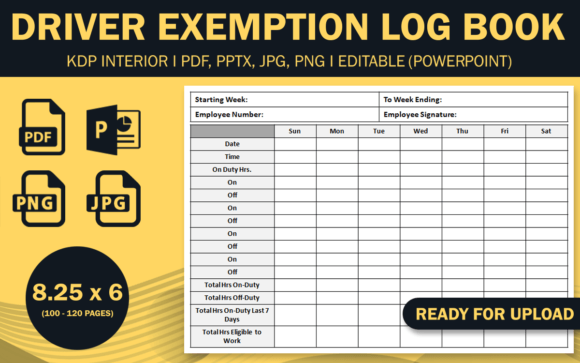
A well-designed driver exemption log book should include the following elements to ensure you capture everything required by regulators:
- Date and time of the exemption event – When did the situation begin and end?
- Type of exemption claimed – Adverse weather, mechanical breakdown, short-haul, agricultural, etc.
- Detailed description of circumstances – What exactly happened? What conditions led to the exemption?
- Location information – Where were you when the exemption started and ended?
- Mileage and driving time affected – How many miles or hours were impacted?
- Supporting notes – Any additional context that helps justify the exemption.
- Driver signature and date – Your attestation that the record is accurate.
Many commercial drivers also use their exemption log book in conjunction with their daily driver log or electronic logging device (ELD) records. While an ELD records your hours automatically, it may not capture the narrative context of an exemption. That's why a separate log book remains valuable even in the age of digital compliance.
Who Needs a Driver Exemption Log Book?
If you operate a commercial motor vehicle that requires a CDL (commercial driver's license) and you are subject to FMCSA HOS rules, you should have an exemption log book. That includes:
- Over-the-road truck drivers – Long-haul drivers who cross state lines and face variable conditions.
- Regional and local delivery drivers – Even within a 150-mile radius, short-haul exemptions require documentation.
- Owner-operators – Independent drivers who must maintain their own compliance records.
- Fleet managers and safety directors – Those who oversee multiple drivers and need to ensure consistent documentation across the fleet.
- Agricultural and seasonal drivers – Drivers who qualify for agricultural exemptions still need to track their time carefully.
Even if you rarely need to claim an exemption, having a log book ready shows a proactive approach to compliance. During a roadside inspection, an officer may ask to see your exemption records for the previous 7 or 8 days. Being able to produce them immediately can prevent a citation or worse.
Practical Examples: When Would You Use an Exemption Log?
Let's look at a few real-world scenarios where a driver exemption log book would be used:
Example 1: Adverse Weather
You're driving through the Midwest in January when a sudden blizzard reduces visibility to near zero. You pull over at a rest stop for 3 hours until conditions improve. To make up for lost time, you extend your driving window by 1.5 hours. In your exemption log, you document the blizzard conditions, the time you waited, and the extended driving period. Without this record, those extra minutes could count as a violation.
Example 2: Mechanical Breakdown
Your truck's alternator fails on a remote stretch of highway. You're stuck for 4 hours waiting for roadside assistance. While waiting, you are technically off duty, but the time lost pushes you close to your 14-hour clock. The FMCSA allows limited relief for unforeseen mechanical issues, but you must document the breakdown and the time spent repairing or waiting. Your exemption log book captures all of that in one place.
Example 3: Short-Haul Exemption
You're a local delivery driver operating within a 75-mile radius of your home terminal. You return to your reporting location each day. Under the short-haul exemption, you are not required to keep a standard log book, but you still need to maintain accurate time records showing you did not exceed the applicable thresholds. An exemption log book designed for short-haul use makes this simple.
Common Misunderstandings and Mistakes
Many drivers and even some fleet managers misunderstand how exemption logs work. Here are the most common pitfalls:
- Mistake 1: Using the exemption as a regular workaround. Exemptions are for unexpected situations, not routine schedule padding. If you regularly claim adverse weather exemptions, regulators will take notice.
- Mistake 2: Not recording the exemption at the time. Waiting until the end of the day to fill in details leads to gaps and inaccuracies. Always log the exemption as it happens.
- Mistake 3: Confusing exemption with exception. An exemption is a permitted extension under specific rules. An exception is a waiver granted by the FMCSA. They are not the same thing.
- Mistake 4: Relying only on an ELD for exemption documentation. ELDs record duty status changes but rarely capture the narrative context. A separate exemption log book provides the story behind the data.
- Mistake 5: Not keeping records long enough. You should retain exemption records for at least 6 months (or longer, depending on your carrier policy).
By understanding these mistakes, you can use your exemption log book correctly and avoid unnecessary compliance headaches.
How to Use a Driver Exemption Log Book Effectively
Using a driver exemption log book is straightforward, but it requires discipline. Follow these steps to stay compliant:
- Keep the log book in your cab at all times. It does you no good if it's in the office or at home.
- Record exemptions immediately. As soon as you encounter a qualifying situation, open the log book and note the time, location, and reason.
- Be specific and honest. Vague entries like "bad weather" are less credible than "heavy snow with 50-foot visibility on I-80 near mile marker 213."
- Cross-reference with your ELD or daily log. Ensure your exemption entries are consistent with your recorded duty status.
- Review and sign each entry. Your signature confirms the accuracy of the record.
- Retain completed logs. Keep them in a secure place for the required retention period.
When you follow these steps consistently, your exemption log book becomes a reliable compliance tool rather than an afterthought.
The Role of Paper vs. Digital Exemption Logs
While electronic logging devices are mandatory for most interstate CMV drivers, the FMCSA does not require digital exemption logs. Many drivers and small fleets still prefer paper-based exemption log books because they are simple, portable, and do not depend on battery power or connectivity. A well-designed paper log book with clear fields makes it easy to capture the details that matter.
However, some fleets use digital tools to track exemptions alongside ELD data. The key is consistency. Whether you use paper or a digital system, your exemption documentation must be accurate, timely, and complete.
For drivers who prepare their own compliance records, a printable or editable driver exemption log book offers the best of both worlds: you can fill it out by hand or customize it digitally before printing. This flexibility is especially useful for owner-operators who want to maintain professional records without investing in expensive software.
Benefits of Using a Structured Exemption Log Book
A dedicated driver exemption log book is not just a compliance requirement. It offers real benefits that make your life easier:
- Peace of mind during inspections. When an officer asks for exemption records, you can produce them instantly.
- Protection against false violations. Your documentation proves that your deviation from the standard rules was legitimate.
- Improved safety culture. When drivers are trained to document exemptions properly, they become more aware of their hours and fatigue risks.
- Better fleet management. For managers, reviewing exemption logs reveals patterns in breakdowns, weather delays, or route challenges that can be addressed proactively.
- Audit readiness. If your carrier is audited by the FMCSA, having complete exemption records demonstrates good faith compliance.
In short, a structured exemption log book is an investment in your professional credibility and your operational safety.
Building a Broader Understanding of Exemption Compliance
Exemption logging is just one piece of the larger compliance puzzle. To fully protect yourself, you should also understand:
- The difference between exemptions (permitted by regulation) and waivers (granted by petition).
- How state-level rules may differ from federal rules. Some states have stricter HOS limits or do not recognize certain exemptions.
- How carrier policies can go beyond federal minimums. Your company may require additional documentation or prohibit certain exemptions altogether.
- The importance of training. Every driver in your fleet should know how and when to use an exemption log book.
The more you understand the rationale behind the regulations, the better equipped you are to stay compliant and keep your career on track.
Final Thoughts: Why Every Driver Needs an Exemption Log Book
The road is unpredictable. Conditions change. Equipment fails. Traffic snarls. When these things happen, you need a reliable way to document your decisions and protect your compliance record. A driver exemption log book gives you that capability in a simple, structured format that regulators trust.
Whether you choose a paper-based log book, a digital template, or a preformatted notebook that fits your cab, the important thing is to use it consistently. Record every exemption as it happens. Be detailed. Be honest. And keep your records organized for inspections and audits.
By doing so, you not only comply with the law. You also demonstrate that you take safety and professionalism seriously. That's good for your reputation, your career, and everyone who shares the road with you.
If you're ready to take control of your compliance documentation, a dedicated driver exemption log book is the smart place to start.