Understanding ADHD Behavior Trackers: A Complete Guide to Daily Logs and Planners
Living with Attention Deficit Hyperactivity Disorder (ADHD) can often feel like trying to navigate a busy intersection without a traffic light. Thoughts race, tasks pile up, and maintaining focus on a single activity can be a monumental challenge. For millions of adults and children, managing ADHD is a daily reality that requires structure, patience, and the right tools. One of the most effective and increasingly popular tools is the ADHD behavior tracker—a dedicated journal or log book designed to bring clarity, accountability, and measurable progress to the chaos. Whether you are someone with ADHD, a caregiver, or a self-publisher looking to create valuable content for platforms like KDP (Kindle Direct Publishing), understanding the interior design and purpose of these trackers is essential.
This guide will walk you through everything you need to know about an ADHD Behavior Tracker Interior for KDP. We will explore what it is, why it matters, how it works in practical terms, and how it can transform daily life. By the end, you will have a clear picture of how a thoughtfully designed daily attention deficit hyperactivity disorder log book can serve as a powerful ally.
What Is an ADHD Behavior Tracker?
An ADHD behavior tracker is a structured log book that helps individuals monitor their behaviors, emotions, routines, and symptoms over time. Unlike a standard journal, which might be open-ended, a behavior tracker uses prompts, checkboxes, rating scales, and sections to capture specific data points. These can include mood levels, medication times, sleep quality, focus duration, impulsivity moments, and daily accomplishments.
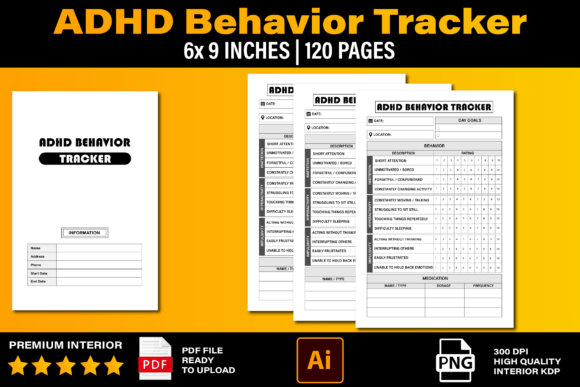
When you purchase an ADHD Behavior Tracker Interior KDP, you are typically buying a PDF, AI file, PNG, or JPG template that you can upload directly to Amazon KDP to create your own print-on-demand journal. The interior you receive is fully formatted, high-resolution, and ready to print—usually around 120 pages, sized at 6 x 9 inches. These files are editable, allowing you to tweak the layout or design to suit your audience better.
The purpose of such a tracker is twofold. First, it provides a consistent framework for the user to log their experiences daily. Second, it creates a historical record that can reveal patterns, triggers, and progress over weeks or months. This insight is invaluable for individuals with ADHD, their therapists, and their families.
Why Use a Daily ADHD Log Book?
ADHD is not simply about difficulty paying attention. It involves challenges with executive functions—the mental processes that help us plan, organize, remember details, and regulate emotions. Without external support, these challenges can lead to missed appointments, unfinished tasks, strained relationships, and low self-esteem.
A daily attention deficit hyperactivity disorder log book addresses these issues directly by offering a consistent structure. By committing to a few minutes of logging each day, users can:
- Track symptoms over time – Notice when symptoms are worse or better and correlate that with sleep, diet, stress, or medication changes.
- Improve self-awareness – Understand personal triggers and patterns that might otherwise go unnoticed.
- Set and review goals – Break down larger objectives into daily action steps and celebrate small wins.
- Communicate with professionals – Bring concrete data to therapy or medical appointments, making discussions more productive.
- Reduce overwhelm – Externalize the mental load of remembering everything, freeing up cognitive resources for deeper focus.
For anyone with ADHD, the simple act of writing things down can be grounding. It creates a moment of stillness and reflection in an otherwise fast-paced mental environment.
Key Components of an Effective Tracker Interior
When examining an ADHD behavior tracker interior for KDP, certain features make it genuinely useful. A well-designed interior goes beyond just blank pages. It incorporates elements that guide the user without feeling rigid or intimidating.
- Daily log pages – These include space for date, mood, medication, sleep, and key behaviors. Rating scales (e.g., 1–5 for focus, energy, or anxiety) help quantify subjective experiences.
- Habit and routine trackers – Simple checkboxes for morning and evening routines, meals, exercise, and hydration support consistency.
- Goal-setting sections – Short-term and long-term goal prompts help users align daily actions with bigger priorities.
- Reflection prompts – Questions like “What went well today?” or “What was challenging?” encourage balanced self-assessment.
- Weekly or monthly summaries – Overview pages allow users to see patterns at a glance, which is incredibly motivating and informative.
- High-resolution, print-ready design – A clean, uncluttered layout with sufficient spacing makes the journal accessible, even for those who struggle with visual processing.
For KDP publishers, having editable files in AI, PDF, PNG, and JPG formats is a major advantage. It means you can customize colors, fonts, or layouts to target specific niches—such as trackers for adults, teens, or parents monitoring their children’s ADHD.
Practical Relevance in Modern Life
We live in a world that demands constant attention, multitasking, and rapid responses. For someone with ADHD, the modern environment can feel like a perfect storm. Notifications, endless to-do lists, and open-plan offices all pull at fragile focus. In this context, an ADHD behavior tracker is not a luxury—it is a practical survival tool.
Consider a typical workday. An employee with ADHD might start the morning with good intentions but get derailed by a sudden email, a colleague’s interruption, or an overwhelming project. By the afternoon, they may feel frustrated and unproductive. If they have been using a daily log book, they can review their morning entries, see that they forgot to take medication or skipped breakfast, and understand why their afternoon energy dipped. The tracker becomes a feedback loop, enabling adjustments in real time.
Similarly, for students, tracking behaviors around study sessions, class participation, and homework completion can reveal which environments or times of day are most conducive to learning. For parents, a tracker used together with their child can foster open communication and reduce blame, shifting the focus to problem-solving.
In the context of KDP publishing, the demand for such resources has grown significantly. As more people recognize the value of neurodiversity-affirming tools, self-publishers have a meaningful opportunity to create products that genuinely help. The interior file you upload must be user-friendly, visually calm, and practically structured to stand out in a crowded marketplace.
Common Misunderstandings About ADHD Trackers
Despite their benefits, some misconceptions surround behavior trackers for ADHD. Let us address a few of them.
Misunderstanding 1: “A tracker is just another thing I will forget to use.”
It is true that consistency can be a challenge with ADHD. However, the tracker itself is designed to build habits. Starting with just one entry per day—perhaps in the evening—creates a low-barrier entry point. Over time, the act of logging can become a comforting ritual rather than a chore.
Misunderstanding 2: “Tracking behaviors will make me feel overly self-critical.”
A well-designed tracker emphasizes neutral observation rather than judgment. Rating scales and open-ended prompts encourage curiosity, not self-criticism. The goal is to learn, not to perform perfectly.
Misunderstanding 3: “These trackers are only for children.”
While many trackers are marketed toward parents, an increasing number are designed specifically for adults. Adults with ADHD face distinct challenges in work, relationships, and financial management, and a tracker tailored to those areas can be highly effective.
Misunderstanding 4: “You need a formal diagnosis to benefit.”
Even individuals who suspect they have ADHD but have not pursued a formal diagnosis can find value in tracking their behaviors. The insights gained can be helpful for self-understanding and can even support a future conversation with a healthcare provider.
How to Get the Most Out of Your ADHD Behavior Tracker
To truly benefit from a daily log book, users should approach it with a spirit of exploration rather than perfection. Here are some practical tips:
- Start small. Fill out only the sections that feel most relevant. You can add more columns or fields over time.
- Keep it visible. Place the journal in a location you see every day—beside your bed, on your desk, or next to your coffee maker.
- Use it alongside other tools. Pair the tracker with digital reminders, visual timers, or accountability partners for maximum effect.
- Review weekly. Spend 10 minutes at the end of each week looking at patterns. Celebrate wins and identify one small change for the following week.
- Share with your support system. If you feel comfortable, show your tracker to a therapist, coach, or trusted friend. They may notice patterns you missed.
Why the Interior Design Matters for KDP Success
For self-publishers, the quality of the interior is paramount. Amazon KDP has a vast catalog, and buyers often judge a book by its cover—and its interior preview. A high-resolution interior with clean design, appropriate margins, and logical flow builds trust. The 6 x 9 inch size is a popular choice for journals because it offers ample writing space without feeling bulky. With 120 pages, the user gets a substantial product that can last three to four months with daily use.
Including editable AI files, along with PDF, PNG, and JPG versions, allows the publisher to adapt the interior for different formats, such as digital downloads or print-on-demand variations. Offering a product that is versatile and professional positions the creator as an expert in the niche.
Moreover, the language used in the tracker—the prompts, labels, and instructions—should be clear, encouraging, and neurodiversity-affirming. Avoid judgmental terms like “bad habit” or “lazy.” Instead, use neutral language such as “behavior observed” or “energy level.” This inclusive approach resonates deeply with the ADHD community.
Bringing It All Together
An ADHD behavior tracker is far more than a collection of pages. It is a bridge between intention and action, between chaos and clarity. For someone living with attention deficit hyperactivity disorder, a daily log book offers a structured way to understand their own mind, celebrate small victories, and navigate challenges with greater ease. For a KDP publisher, creating a high-quality interior is an opportunity to contribute meaningful resources to a community that craves practical support.
Whether you are a user looking for your next journal or a creator designing your next product, remember that the best ADHD trackers share a few key qualities: they are simple, consistent, encouraging, and built for real life. By focusing on these principles, you can create or choose a journal that truly makes a difference.
In the end, managing ADHD is not about fixing something that is broken. It is about building systems that honor how your brain works. A well-designed behavior tracker is one of those systems—a quiet, dependable companion in the journey toward greater self-awareness and balance.