The Complete Guide to the Acceptance Guided Journal Template
Journaling has long been recognized as a powerful tool for mental clarity, emotional regulation, and personal growth. Yet, for many, the practice can feel unstructured or overwhelming. The Acceptance Guided Journal Template bridges this gap by combining evidence-based therapeutic principles with a practical, easy-to-use format. Whether you are a therapist, coach, educator, or someone seeking deeper self-understanding, this template offers a structured yet flexible pathway toward acceptance and well-being.
What Is the Acceptance Guided Journal Template?
At its core, the Acceptance Guided Journal Template is a collection of thoughtfully designed journal pages rooted in the principles of Acceptance and Commitment Therapy (ACT). It provides a framework for exploring key concepts such as reality acceptance, emotional acceptance, self-acceptance, cognitive diffusion, and values-based living. Rather than asking you to start from scratch, this template gives you a ready-to-use structure that guides your reflection in meaningful directions.
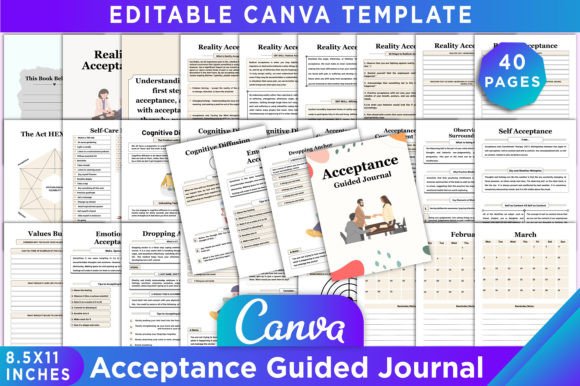
The template includes 40 unique Canva templates, each crafted to support a specific aspect of the acceptance journey. From the ACT Hexaflex to the Values Bullseye, every page serves a distinct purpose. The set is designed for print at 8.5x11 inches, with high-quality PDF, JPEG, and PNG files, plus an editable Canva link that lets you customize the journal to your own needs.
Understanding the Core Components
To truly appreciate the Acceptance Guided Journal Template, it helps to explore the individual pages and the role they play. Each component targets a different dimension of acceptance and growth.
Reality Acceptance Pages
These pages invite you to acknowledge what is true in the present moment, without judgment or resistance. Reality acceptance is a foundational skill in ACT, and these journal prompts help you practice seeing the world as it is, rather than as you wish it to be. You will find six unique pages dedicated to this theme, offering varied exercises to deepen your practice.
Emotional Acceptance
Emotions can be uncomfortable, especially the difficult ones. The emotional acceptance pages guide you to sit with your feelings, label them, and understand their messages. This is not about wallowing, but about allowing emotions to exist without letting them dictate your actions.
Self-Acceptance
Perhaps the most challenging form of acceptance is accepting yourself—your strengths, your flaws, your history. The self-acceptance pages offer prompts that encourage compassion, forgiveness, and a realistic yet kind view of who you are.
Cognitive Diffusion
Our thoughts can trap us. Cognitive diffusion is the practice of stepping back from thoughts and observing them as mental events, not absolute truths. The template includes three unique pages on cognitive diffusion, helping you create distance from unhelpful thinking patterns.
The ACT Hexaflex
One of the standout features is the ACT Hexaflex page, which visually maps the six core processes of Acceptance and Commitment Therapy: acceptance, cognitive defusion, being present, self-as-context, values, and committed action. This page serves as both an overview and a practical tool for tracking your progress across all dimensions.
Your Values and the Values Bullseye
Values are the compass that guides meaningful action. The template includes a dedicated page for exploring your values and a Values Bullseye page that helps you assess how closely your daily life aligns with what matters most to you. These are among the most actionable pages in the entire set.
Dropping Anchor
When you feel overwhelmed by difficult emotions or thoughts, the Dropping Anchor technique offers a way to ground yourself. Two unique pages guide you through this practice, helping you stay present and centered in moments of distress.
Observing Surroundings and Self-Care Ideas
Mindfulness extends beyond internal experience. The Observing Surroundings page encourages you to engage with your environment using all your senses. The Self-Care Ideas page provides prompts for identifying activities that nurture your well-being, making self-care a concrete part of your routine.
Practical Tools: Monthly Planner, Notes, and Checklist
Beyond the therapeutic pages, the template includes a Monthly Planner for tracking your journaling practice, a Notes section for free-form reflection, and a Checklist that includes a "This Book Belongs To" page. These practical elements ensure the journal fits seamlessly into your daily life.
Who Can Benefit from This Template?
The Acceptance Guided Journal Template is remarkably versatile. It is suitable for a wide range of users, each of whom can adapt it to their specific context.
- Therapists and counselors can use the template as a take-home resource for clients, reinforcing the work done in sessions. The ACT-based pages align directly with therapeutic goals.
- Life coaches and wellness practitioners can incorporate the journal into coaching programs, workshops, or retreats. It offers a structured way for clients to explore values and emotional patterns.
- Educators and school counselors may find the template helpful for teaching emotional literacy and resilience to students. The language is accessible and the exercises are straightforward.
- Individuals on a personal growth journey can use the journal independently. The prompts are self-explanatory, making it easy to start without prior knowledge of ACT.
- Creators and business owners can customize the template using the editable Canva link, rebrand it, and offer it as a product to their own audience.
Practical Features and File Specifications
One of the strengths of this template is the range of formats included. You receive high-quality PDF files for printing, JPEG and PNG files for digital use, and an editable Canva link that lets you modify every element. The print dimensions are 8.5x11 inches, with CMYK color and 300 DPI resolution, ensuring professional results whether you print at home or through a service. There is no bleed, which simplifies the printing process.
To keep the original link active, simply go to your Canva home and make a copy of the document into your own account. Work on that copy, and the original remains untouched. This is a simple step that preserves your access and the integrity of the original design.
The template includes 40 Canva templates in total, covering all the pages mentioned earlier. This is a comprehensive set that gives you everything you need to create a complete acceptance journal.
Real-World Applications and Scenarios
Imagine a therapist working with a client who struggles with self-criticism. The therapist introduces the Self-Acceptance pages and the Cognitive Diffusion pages. Over several weeks, the client uses the prompts to identify harsh self-judgments and practice seeing them as just thoughts, not facts. The Values Bullseye helps the client realize they have been neglecting their value of creativity. Together, they create a plan for committed action.
Or consider a coach running a six-week group program on emotional resilience. Each week, participants focus on a different page from the Acceptance Guided Journal Template. Week one is Reality Acceptance, week two is Emotional Acceptance, and so on. By the end, the group has a completed journal that documents their growth. The editable Canva link allows the coach to add their own branding or supplementary prompts.
For an individual using the journal at home, the Monthly Planner page helps establish a consistent practice. The Dropping Anchor pages become a go-to tool during moments of anxiety. Over time, the journal becomes a personal record of increasing self-awareness and acceptance.
Strengths and Considerations
The Acceptance Guided Journal Template has several notable strengths. First, its foundation in ACT gives it credibility and depth. The pages are not arbitrary; they target specific psychological skills that have been extensively researched. Second, the variety of formats (PDF, JPEG, PNG, editable Canva link) ensures flexibility for different use cases. Third, the design is clean and professional, making it suitable for both personal and commercial use.
One consideration is that the template assumes some basic familiarity with acceptance-based concepts. While the prompts are clear, users entirely new to ACT may need a brief introduction to terms like "cognitive diffusion" or "hexaflex." A solution is to include a short guide or glossary alongside the journal, which you can easily add using the editable Canva link.
Another consideration is the print specification. The 8.5x11 inch size with no bleed is straightforward for home printers and most print shops, but if you plan to use a professional binder, you may need to adjust margins. Again, the editable Canva link makes this adjustment simple.
Finally, the sheer number of pages (40 templates) may feel overwhelming to some users. It is helpful to remember that you are not required to use every page. You can select the ones most relevant to your current needs and return to the others when you are ready.
How to Evaluate Suitability for Your Needs
When deciding whether this template is right for you, consider the following questions:
- What is your primary goal? If you are looking for a structured, evidence-based journal that goes beyond generic prompts, this template is an excellent fit.
- Who is your audience? If you work with clients or students who need clear, guided exercises, the ACT-based pages will serve you well.
- How much customization do you need? The editable Canva link gives you full control over colors, fonts, and layout, making it easy to adapt the template to your brand or personal style.
- What format do you prefer? The availability of PDF, JPEG, and PNG files means you can use the journal digitally, print it, or share it in multiple ways.
- Are you comfortable with a therapeutic framework? If you prefer a more general journaling approach, some of the ACT-specific language may feel unfamiliar at first, but the prompts remain accessible.
Maximizing the Value of Your Journal
To get the most out of the Acceptance Guided Journal Template, consider integrating it into a regular routine. Set aside 10–15 minutes each day or several times per week to work through a page. Pair it with other practices like meditation, therapy, or coaching for a more holistic approach. Review your entries periodically to observe patterns and growth.
If you are using the template with clients or students, introduce each page in a logical sequence. Start with reality acceptance and observing surroundings, then move to emotional acceptance and cognitive diffusion, and finally explore values and committed action. The ACT Hexaflex page can serve as a roadmap for the entire journey.
The editable Canva link also allows you to create multiple versions of the journal for different purposes. For example, you could create a "starter" version with a subset of pages, a "full" version with all 40 templates, and a "therapist" version with additional prompts. This flexibility makes the template a scalable resource.
Final Thoughts
The Acceptance Guided Journal Template is more than just a collection of pages; it is a practical tool for cultivating acceptance in its many forms. Whether you are a professional supporting others or an individual on your own path, the template offers a clear, structured, and customizable way to engage with acceptance-based practices. With 40 templates, high-quality file formats, and an editable Canva link, it provides everything you need to create a journal that is both personal and professional. If you are looking for a resource that combines therapeutic depth with everyday usability, this template is well worth exploring.