Pharmacology & Med-Surg Study Templates
Mastering the dual demands of pharmacology and medical-surgical nursing requires more than just memorization—it demands a system that organizes complex information into a form your brain can actually use. Pharmacology and med-surg study templates provide exactly that: a structured framework that transforms dense, multi-layered content into clear, actionable notes. These templates are designed to help you build clinical reasoning skills, retain critical details, and move from passive reading to active learning. Whether you are a nursing student preparing for exams, an educator developing course materials, or a practicing clinician refreshing your knowledge, a well-crafted study template can be the difference between information overload and confident recall.
What makes these templates particularly powerful is their intentional design. Each section is placed to guide your thinking from pathophysiology through to nursing interventions, mirroring the clinical decision-making process you will use at the bedside. The pharmacology templates follow a similar logic, leading you from drug class and mechanism to patient education and adverse reactions. This structure is not arbitrary—it reflects how information needs to be connected for safe, effective practice. The visual layout, often with clear headings, spacing, and perhaps subtle color coding, reduces cognitive load so you can focus on understanding relationships rather than wrestling with disorganized notes.
Beyond their obvious study utility, these templates offer rich creative possibilities. An educator might use a completed template as a handout, annotating it with clinical pearls or case examples. A blogger or digital creator can adapt the template design into an infographic, social media carousel, or a downloadable PDF for a professional audience. A freelance designer can take the core structure and reimagine it for different learning styles—adding icons, flowcharts, or a minimalist aesthetic. The flexibility of a well-designed template means it can serve as a foundation for many formats, from printable study sheets to interactive digital notebooks.
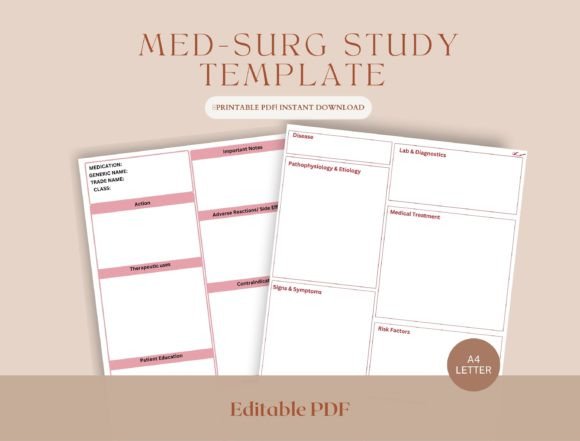
The med-surg study template begins with the disease name, setting the context for everything that follows. The pathophysiology and etiology section then grounds you in the “why” behind the condition—what has gone wrong at the cellular or systemic level. This understanding is crucial because it directly informs the signs and symptoms you will observe, the complications you must anticipate, and the nursing interventions you will prioritize. For example, if you know that heart failure involves reduced cardiac output and fluid overload, the connection to symptoms like dyspnea, edema, and fatigue becomes intuitive rather than a list to memorize. The complications section then forces you to think ahead: what can go wrong, and how will you recognize it early? This proactive mindset is a hallmark of expert clinical judgment.
Labs and diagnostics follow, giving you the objective data points that confirm or rule out the condition. Here, the template helps you move beyond simply listing normal ranges. You can note why a specific lab is relevant, what a trend might indicate, and how the results influence treatment decisions. Risk factors tie back to prevention and patient education, a reminder that nursing care extends beyond the hospital stay. Finally, nursing interventions bring everything together into actions you can perform, delegate, or teach. The template does not just ask for a list of interventions; it encourages you to prioritize them, consider patient-specific adaptations, and evaluate outcomes. This integrated approach builds the critical thinking skills that exams and real-world practice demand.
The pharmacology drug template complements the med-surg template by focusing on safe medication administration. Starting with the generic and trade names, as well as the drug class, anchors the medication in a broader category, which helps you predict actions and side effects. The action section should be succinct but mechanistic—describing how the drug affects the body at the receptor or system level. Therapeutic uses then specify the conditions for which the drug is indicated, often cross-referencing with the med-surg templates you have already completed. Patient education is a vital component; the template prompts you to consider what the patient needs to know for safe self-management, including adherence strategies, dietary restrictions, and when to seek help. Important notes might include monitoring parameters, administration tips (e.g., giving with food), or specific populations (pediatric, geriatric, renal impairment). Adverse reactions are listed by system and frequency, helping you distinguish between common annoyances and dangerous events. Contraindications prevent unsafe prescribing, and nursing considerations tie everything to assessment, intervention, and evaluation. By filling out these templates consistently, you build a mental library of drug profiles that supports fast, accurate clinical decisions.
Different users will adapt these templates to their own goals. A student might print a stack of blank templates and fill them out by hand during lecture or while reading the textbook. This kinesthetic process reinforces memory and forces active engagement with the material. An educator could use a completed template as a model for students, then challenge them to create their own for a different condition or drug. A blogger or small business owner might offer a beautifully designed, printable set of templates as a digital product—either free to build an email list or for sale on a platform like Etsy or Gumroad. These templates can be branded, customized with different color schemes, or even turned into a Notion or GoodNotes digital planner. The key is to maintain the logical structure that makes the learning effective, while adapting the visual style to your target audience.
For creators selling templates, the appeal lies in both functionality and aesthetics. A clear, uncluttered layout using a professional font and consistent hierarchy inspires confidence. You might include a sample completed page to show the template in action. An A4 size ensures compatibility with standard printers and most digital note-taking apps. The “print as much as you can” flexibility is a strong selling point—educators and students alike appreciate the freedom to reproduce templates for personal or classroom use. If you are a blogger or influencer, you can create an in-depth post showing how you use the templates in your own study routine, pairing it with a free downloadable sample to demonstrate value. Entrepreneurs in the nursing education space could develop themed bundles: a cardiac med-surg pack, a respiratory pharmacology pack, or a full semester set. The modular nature of the template structure makes it easy to expand over time.
Keeping your study results clear and effective comes down to consistency in how you populate the templates. Avoid copying long paragraphs from a textbook. Instead, use bullet points, short phrases, and your own words. Add mnemonics, drawings, or color-coded highlights that make sense to you. If you are using the templates digitally, consider linking related templates—a drug template can link back to the conditions it treats, and a disease template can link forward to the medications covered in that unit. This creates a web of knowledge rather than isolated facts. Reviewing your completed templates periodically, especially by covering sections and trying to recall them, turns passive notes into active retrieval practice. The templates become a self-testing tool, not just a reference.
Audience-friendly design is equally important. If you are creating templates for others, test them with real users. Ask: Is the font large enough? Are the section headings intuitive? Is there enough space to write? Do the colors distract or assist? A minimalist black-and-white version may be best for printing, while a digital version could use subtle shading to group related content. Including instructions or a sample page reduces confusion and increases perceived value. For a professional audience, such as educators or clinical preceptors, you might include an example for a common condition (e.g., diabetes mellitus or hypertension) to showcase the template’s utility. The goal is to reduce friction so the user can focus on learning, not on figuring out the template.
Ultimately, pharmacology and med-surg study templates are more than note-taking aids—they are frameworks for clinical thinking. They encourage you to connect pathophysiology to presentation, lab values to interventions, and drug mechanisms to patient education. By using them consistently, you train your mind to think in the structured, logical way that safe nursing practice requires. Whether you are studying for the NCLEX, developing a resource for your students, or building a product line for your audience, these templates offer a proven structure that can be adapted, customized, and scaled. The best approach is to start simple, use the template as designed, and then iterate based on your specific needs. With each completed template, you are not just storing information—you are building a system of clinical reasoning that will serve you throughout your career.
Embrace the structure, make it your own, and let the templates guide you toward deeper understanding and lasting competence. The effort you invest in organizing your knowledge now will pay dividends every time you step into a clinical setting or help a patient understand their care. That is the real value of a thoughtful study template—it turns information into practice.