Space Word Search Workbook for Kids: A Practical Review for KDP Publishers and Educators
Creating engaging, educational content for children requires a careful balance between fun and learning. Word search puzzles have long been a staple in activity books, but when you combine them with a theme as captivating as outer space, you open the door to a uniquely motivating experience. The Space Word Search Workbook for Kids offers exactly this combination, and for anyone evaluating printable or KDP-ready puzzle books, understanding what this resource provides and where it fits among other options is essential.
This article examines the Space Word Search Workbook for Kids in detail, explores how it compares to similar puzzle workbooks, discusses its strengths and limitations, and helps you determine whether it aligns with your project goals or your child's learning needs. Whether you are a publisher looking for a ready-to-upload KDP file, a teacher seeking supplemental materials, or a parent hunting for screen-free activities, a clear-eyed assessment of this workbook will help you make an informed choice.
What the Space Word Search Workbook for Kids Offers
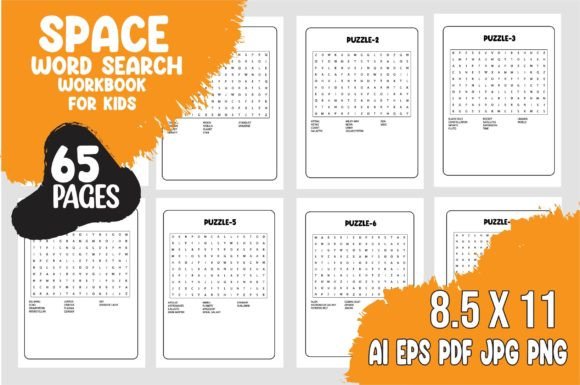
At its core, the Space Word Search Workbook for Kids is a collection of 50 space-themed word search puzzles designed for children. Each puzzle occupies its own page, answers are included at a ratio of four answer sets per page, and the total document runs 65 pages. The workbook is delivered in multiple formats: a print-ready PDF, an editable AI (Adobe Illustrator) source file, an EPS file, a PNG file, and a JPG file. All files are formatted at 8.5 by 11 inches, the standard US letter size, which makes them compatible with both home printers and commercial publishing platforms.
What distinguishes this workbook from a simple puzzle collection is the combination of the space theme with the editable source files. The space theme itself is a strong draw. Children are naturally curious about planets, stars, astronauts, rockets, and galaxies, and a word search built around these terms can reinforce vocabulary while sustaining interest. The editable AI file means that a publisher or educator can modify the puzzles, change words, adjust the layout, or rebrand the entire workbook. This level of customization is not always available with standard puzzle books, and it is a significant advantage for anyone who wants to tailor the content to a specific audience or curriculum.
How It Compares with Other Puzzle Workbooks
When evaluating the Space Word Search Workbook for Kids, it is helpful to consider the broader landscape of children's word search workbooks. Many puzzle books on the market are sold as PDF-only files with no editable source. They are ready to print but cannot be altered. Others are sold as physical books only, with no digital flexibility. This workbook sits in a middle ground: it offers both a print-ready PDF and editable vector files, giving the buyer control over the final product.
Another common alternative is the generic word search workbook that covers multiple themes in a single volume. For example, a book might include animal puzzles, sports puzzles, and holiday puzzles all mixed together. While that variety can be useful, it also means that a child who is specifically interested in space will only get a handful of relevant puzzles. The Space Word Search Workbook for Kids is focused entirely on one theme, which makes it a stronger choice for thematic learning units, space-themed birthday parties, or classroom enrichment tied to a science module.
There are also free word search generators available online. These allow you to create custom puzzles on demand, but they rarely produce a polished, print-ready book with consistent formatting, answer keys, and professional layout. The time saved by using a pre-made workbook like this one is considerable. Instead of designing each puzzle from scratch, you receive a complete set of 50 puzzles that are already balanced in terms of word placement, difficulty, and visual consistency.
Strengths of the Space Word Search Workbook for Kids
The most obvious strength is the convenience of the all-in-one package. You receive the PDF ready to upload to KDP, along with editable files if you need to make changes. For a publisher, this eliminates the need to hire a designer or spend hours formatting puzzles. For a teacher or parent, the PDF can be printed immediately with no additional software.
The space theme itself is a well-researched choice. Children often find space topics intrinsically motivating. Words like "asteroid," "telescope," "orbit," and "constellation" are not only fun to search for but also introduce scientific vocabulary in a low-pressure context. The workbook supports vocabulary building, pattern recognition, and visual scanning skills, all of which are important for early literacy and cognitive development.
Another strength is the editable source file. If you want to change the title, add your own branding, swap out a few words to match a specific lesson plan, or even translate the puzzles into another language, you can do so using Adobe Illustrator. This flexibility is rare among ready-made puzzle books and adds significant value for anyone who needs to customize the content.
The answer key inclusion is also worth noting. Many puzzle books omit answers to save space or because they assume the puzzles are easy enough to check visually. However, for classroom use or for parents who want to verify solutions quickly, having the answers organized and included is a practical benefit. The format of four answers per page keeps the answer section compact without being cramped.
Limitations and Tradeoffs to Consider
No resource is perfect for every situation, and the Space Word Search Workbook for Kids has a few tradeoffs worth examining. The first is the file format. While the AI file is editable, it requires Adobe Illustrator to open and modify. If you do not own that software, or if you are not comfortable working with vector graphics, the editable file may be of limited use. In that case, the PDF and PNG files still serve well, but the customization advantage is reduced.
Another consideration is the age range. Word searches are generally suitable for children who are already comfortable with letter recognition and basic reading. For very young children or those who struggle with visual scanning, the puzzles might feel frustrating rather than fun. The workbook does not specify a grade level or age range on the specification sheet, so you will need to assess whether the vocabulary and grid complexity match your target audience. Looking at sample pages, if available, can help you gauge this fit.
The single-theme focus is a strength for some users but a limitation for others. If you are looking for a general-purpose puzzle book that covers many topics, this workbook will not provide that variety. A child who finishes all 50 puzzles quickly may lose interest unless they have a sustained passion for space. In that case, you might need multiple themed workbooks to maintain engagement over time.
Additionally, the workbook is designed for one puzzle per page. Some educators prefer a denser layout with two puzzles per page to reduce paper usage. The 8.5 by 11 inch format with one puzzle per page is generous and easy on the eyes, but it does mean the workbook uses more paper than a more compact design would. For home printing, this is usually fine, but for a publisher printing hundreds of copies, the page count directly affects production cost.
When This Workbook Is the Right Choice
The Space Word Search Workbook for Kids is an excellent fit for several specific scenarios. If you are a KDP publisher looking for a niche product that targets a popular theme, this workbook gives you a polished, ready-to-upload file that requires minimal additional work. You can add your own cover, adjust the title, and publish within hours. The editable source file also allows you to create variations, such as a "hard" version or a "junior" version, by modifying the word lists and grid sizes.
For educators planning a unit on space or the solar system, this workbook serves as a supplemental activity that reinforces vocabulary in a fun way. It can be used as a morning warm-up, a center activity, or a take-home assignment. Having 50 puzzles means you can spread them across several weeks without repeating any content.
For parents who want to encourage reading and spelling through a topic their child already loves, this workbook offers a structured but playful approach. It is also a travel-friendly activity, since word searches require no special equipment beyond a pencil. The PDF can be printed in batches, making it easy to bring along on car trips or plane rides.
When Another Option Might Be Better
If you need a puzzle book for a wide age range within a single classroom, a single-level word search workbook may not meet all students' needs. Some children will breeze through the puzzles while others struggle. In that case, a workbook with differentiated difficulty levels or a mix of puzzle types might serve better. Alternatively, you could purchase this workbook and supplement it with easier or harder puzzles from other sources.
If you are looking for a fully interactive digital activity, word search puzzles are inherently print-based. While you can use the PNG files on a tablet with a drawing app, the experience is not as smooth as a dedicated digital puzzle app. For digital-only use, an app might be a better investment.
If your priority is cost, and you have the time to design your own puzzles, free online generators can produce similar results at no monetary cost. However, the tradeoff is the time spent designing, formatting, and checking each puzzle. The value of this workbook lies in the hours it saves and the professional consistency of the output.
Key Decision Factors to Weigh
When deciding whether the Space Word Search Workbook for Kids is right for your project, consider the following factors:
- Customization need: If you want to modify the content, the AI file is valuable. If you only need a print-ready product, the PDF alone suffices.
- Theme specificity: A space-only workbook is ideal for thematic use but less suitable for general variety.
- Age and skill level: Ensure the vocabulary and grid complexity match the child's reading ability.
- Format preference: The standard 8.5 by 11 inch size and one-puzzle-per-page layout are clean and readable but use more paper.
- Production scale: For small print runs or home printing, the PDF works perfectly. For large-scale commercial printing, verify that the file meets your printer's specifications.
- Software access: The AI file requires Adobe Illustrator. If you lack this software, consider whether the other included formats are enough.
Practical Examples of Use
Imagine a third-grade teacher preparing a two-week unit on the solar system. She prints one puzzle per day and uses it as a warm-up activity. The students search for words like "Mercury," "gravity," and "orbit," which reinforces the vocabulary introduced in the science lesson. By the end of the unit, the class has completed ten puzzles, and the teacher has used only a fraction of the workbook, leaving the rest for future units or early finisher activities.
Now consider a KDP publisher who wants to launch a series of themed word search books. They purchase this workbook, open the AI file, change the title and cover, and upload the PDF to Amazon. The editable source file allows them to create a branded series with consistent formatting across multiple themes. They can also adjust the difficulty for different age groups by editing the word lists. This flexibility transforms a single purchase into a scalable product line.
Conversely, a parent looking for a one-time activity for a long flight might find 50 puzzles excessive. A smaller, cheaper workbook or a printable set from a teacher pay site might be more economical. However, if the child is deeply interested in space, having extra puzzles available is a bonus rather than a drawback.
Final Thoughts on the Space Word Search Workbook for Kids
The Space Word Search Workbook for Kids occupies a practical niche in the world of children's activity books. It combines a highly appealing theme with professional formatting and the rare advantage of editable source files. It is not a one-size-fits-all solution, but for the right user, it offers significant value in terms of convenience, customization, and educational relevance.
When comparing options, focus on your specific needs: the age of the child, the intended use context, your willingness to customize, and your printing or publishing requirements. A focused, themed workbook like this one can be a powerful tool when matched to the right situation. For space-loving kids, busy teachers, and savvy publishers, it is well worth considering.